
Why Family EVs Are Changing the Suburban Landscape
The automotive world is in the midst of a quiet revolution, and family EVs are at its heart. Parents who once dreaded the high cost of gasoline are now eyeing electric SUVs and sedans that promise low‑running costs, zero emissions, and a suite of safety tech that keeps kids secure. In 2024, two contenders stand out for families looking to make the switch: the Tesla Model Y and the Hyundai Ioniq 6. Both promise a blend of performance and practicality, but which one truly earns the family badge of honor? Let’s explore the details that matter most to everyday drivers.
Key Buying Criteria for Family EVs
Before diving into model‑specific data, it helps to set a baseline of what most families consider essential when shopping for an electric vehicle. These criteria cut through the hype and focus on real‑world usability.
Space & Seating
- Third‑row availability or flexible cargo configurations.
- Easy‑access rear doors and low step‑over height for child seats.
- Flat floor design that maximizes interior volume.
Safety Technology
- Standard advanced driver‑assistance systems (ADAS) such as automatic emergency braking, lane‑keep assist, and blind‑spot monitoring.
- High safety ratings from NHTSA and IIHS.
- Child‑seat anchor points (LATCH) in every rear seat.
Range & Efficiency
- Real‑world EPA range that comfortably covers weekly school runs, weekend trips, and occasional long drives.
- Consistent energy consumption (MPGe) under mixed‑city/highway conditions.
- Availability of fast‑charging networks along common family travel corridors.
Ownership Costs
- Purchase price vs. total cost of ownership (TCO) over five years.
- Eligibility for federal and state EV tax credits.
- Maintenance savings from fewer moving parts and regenerative braking.
2024 Tesla Model Y: Strengths and Weaknesses for Families
The Model Y has become Tesla’s flagship compact SUV, and its 2024 refresh adds subtle styling tweaks and an updated interior. Here’s how it stacks up for families.
Performance & Driving Experience
- Dual‑motor all‑wheel drive delivers 0‑60 mph in under 4.8 seconds—quick enough for highway merges but still comfortable for city cruising.
- Regenerative braking feels natural, extending range on stop‑and‑go school runs.
- Low center of gravity thanks to the floor‑mounted battery improves handling on winding suburban roads.
Interior Space & Practicality
- Seating for up to seven with an optional third row, though the third‑row seats are best suited for children under 40 lb.
- 150 cu ft of cargo volume with rear seats folded, enough for strollers, groceries, and sports gear.
- Panoramic glass roof adds a feeling of openness but can increase cabin heat on sunny days.
Safety & Tech
- Standard Full Self‑Driving (FSD) beta (where legal) offers advanced lane‑changing and traffic‑aware cruise control.
- Eight airbags, automatic emergency braking, and Tesla’s renowned Crash‑Safety Architecture.
- Large 15‑inch touchscreen consolidates infotainment, climate, and vehicle settings, but may distract drivers unfamiliar with the UI.
Range, Charging, and Infrastructure
- EPA‑estimated 330 miles on the Long‑Range dual‑motor version—ample for most weekly family trips.
- Access to Tesla’s Supercharger network, averaging 250 kW fast‑charge speeds, reduces a 0‑80 % charge to roughly 25 minutes.
- Home charging with a 12 kW Wall Connector adds ~30 miles per hour of charge.
Cost Considerations
- Starting price around $58,000 before destination and options.
- Potential federal tax credit of $7,500 (subject to phase‑out rules) and various state rebates.
- Higher insurance premiums due to repair costs and advanced tech.
2024 Hyundai Ioniq 6: Strengths and Weaknesses for Families
Hyundai’s Ioniq 6 brings a sleek, aerodynamic sedan design to the family EV arena. Its 2024 model refines interior quality and adds new driver‑assist features that appeal to safety‑first households.
Performance & Driving Experience
- Available in rear‑wheel‑drive (RWD) and all‑wheel‑drive (AWD) configurations; AWD version hits 0‑60 mph in about 5.2 seconds.
- Quiet cabin thanks to extensive sound‑deadening and aerodynamic shaping.
- Predictable handling, making it comfortable for drivers of all skill levels.
Interior Space & Practicality
- Seating for five with generous rear‑legroom (31.5 in) that rivals many compact SUVs.
- 225 cu ft of cargo capacity with rear seats folded—more than the Model Y’s standard configuration.
- Flat floor and a 12.3‑inch digital instrument cluster paired with a 14.5‑inch infotainment screen.
Safety & Tech
- Hyundai SmartSense suite includes Highway‑Driving Assist, Forward Collision‑Avoidance Assist, and Remote Smart Parking Assist.
- Five‑star NHTSA rating and IIHS Top Safety Pick+.
- Standard rear‑seat reminder and built‑in child‑seat anchor points in both rear rows.
Range, Charging, and Infrastructure
- EPA‑estimated 340 miles on the Long‑Range RWD version—slightly higher than the Model Y.
- Supports 240 kW DC fast charging; 10‑minute charge adds roughly 80 miles.
- Hyundai’s partnership with ChargePoint and Electrify America expands public charging options.
Cost Considerations
- Starting price around $55,000 before destination.
- Qualifies for the full $7,500 federal tax credit and many state incentives.
- Generally lower insurance costs compared to Tesla, thanks to broader repair network.
Side‑by‑Side Comparison: Which Model Serves Families Better?
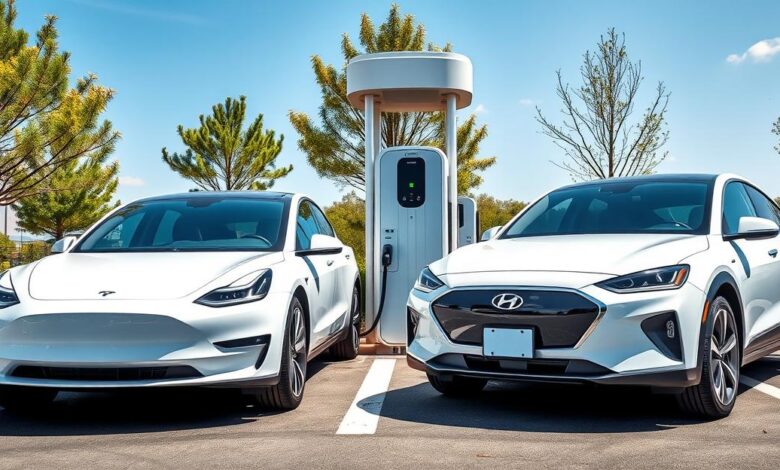
Both the Tesla Model Y and Hyundai Ioniq 6 bring compelling arguments to the family EV table. Below is a concise comparison that highlights the most relevant factors for parents and caregivers.
Comparison of 2024 Tesla Model Y vs. Hyundai Ioniq 6 for Family Use
| Feature | Tesla Model Y | Hyundai Ioniq 6 |
|---|---|---|
| Starting Price (USD) | $58,000 | $55,000 |
| EPA Range | 330 miles | 340 miles |
| Seating Capacity | 5‑7 (optional 3rd row) | 5 |
| Cargo Volume (cu ft) | 150 (max) | 225 (max) |
| Fast‑Charging Speed | Up to 250 kW (Supercharger) | Up to 240 kW (CCS) |
| Standard Safety Tech | Autopilot, 8 airbags | SmartSense suite, 5‑star NHTSA |
| Warranty | 4‑yr/50,000 mi | 5‑yr/60,000 mi + 10‑yr/100,000 mi battery |
| Best For | Tech‑savvy families who value supercharging network | Families prioritizing interior space and lower ownership cost |
Financing and Incentives: Getting the Best Deal on a Family EV
Even the most appealing family EV can feel out of reach without a smart financing strategy. Below are actionable steps to keep your total cost of ownership under control.
Leasing vs. Buying
- Leasing offers lower monthly payments and the flexibility to upgrade every 2‑3 years, which is useful as battery technology improves.
- Buying builds equity, especially when you can take advantage of the federal tax credit and state rebates that effectively reduce the purchase price.
- Calculate the net present value of each option over a five‑year horizon to see which aligns with your family’s budget.
Take Advantage of Federal and State Incentives
- The $7,500 federal EV tax credit applies to both the Model Y and Ioniq 6, but watch for income caps and vehicle price limits.
- Many states offer additional rebates, reduced registration fees, or access to HOV lanes—check your local DMV website.
- Utility companies sometimes provide discounted home‑charging installations; inquire about “green rate” programs.
Shop for the Best Financing Rate
- Credit unions often offer lower APRs than traditional banks for EV loans.
- Consider a 0‑% promotional rate from the manufacturer’s financing arm, but read the fine print for early‑payoff penalties.
- Keep your credit score above 720 to qualify for the most favorable terms.
Insurance Savings Tips
- Bundle auto and home insurance with the same carrier to unlock multi‑policy discounts.
- Ask insurers about EV‑specific discounts for low‑risk drivers and vehicles equipped with advanced safety systems.
- Install a home‑charging station; some insurers view it as a risk‑mitigation measure and lower premiums.
Real‑World Scenarios: How Families Use Their EVs Day‑to‑Day
Understanding how a vehicle fits into daily life helps you decide which model aligns with your routine.
Morning School Run
- Both models provide ample rear‑seat space for car seats, but the Ioniq 6’s lower step‑over height makes it easier for parents to lift children in and out.
- Regenerative braking on the Model Y can recover energy during stop‑and‑go traffic, slightly extending range for the day.
Weekend Getaway
- A family of four heading to a beach town will appreciate the Model Y’s optional third row for extra luggage, while the Ioniq 6’s larger trunk can hold surfboards or bike racks without folding seats.
- Supercharger availability along major highways gives the